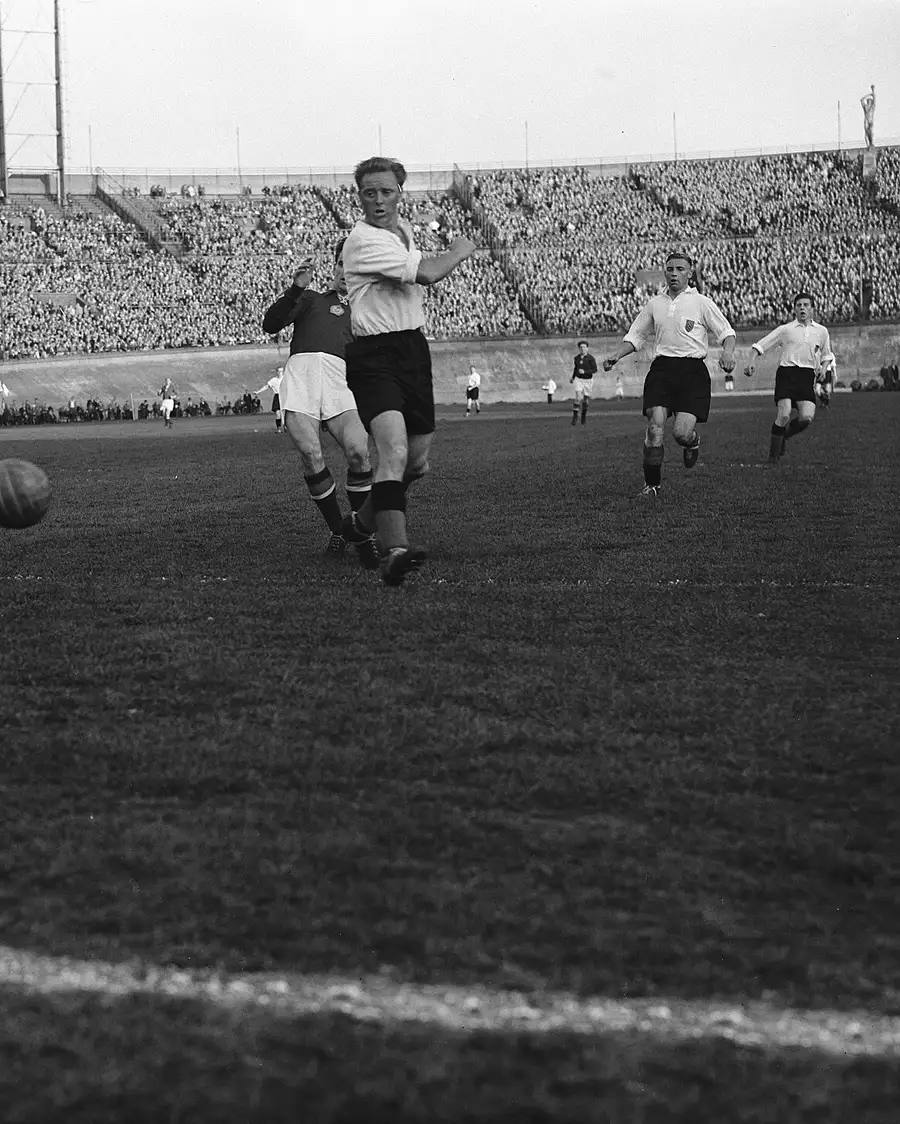
The law changes
In 1925 the offside law is relaxed: an attacker now needs two opponents ahead of him, not three. Goals pour in, and the old shape is open through the middle.
Discover the ideas that changed football, then set up your own. The same move plays like a match in 2D and 3D, and reaches your team as a video or a link.
No account needed.
Photo: Wim van Rossem / Anefo, Nationaal Archief, 1954 (CC0)
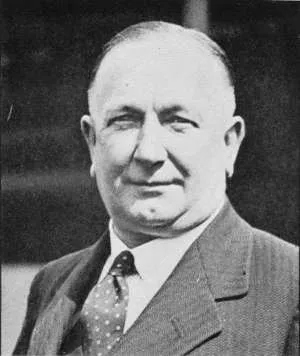
1925Herbert Chapman
A law changed. He redrew the pitch.
In 1925 the offside law is relaxed: an attacker now needs two opponents ahead of him, not three. Goals pour in, and the old shape is open through the middle.
Chapman, newly in charge of Arsenal, pulls the man in the middle of midfield back between the two full-backs. The third back is born.
Both inside forwards come deeper too. An M at the back, a W in front: the side is balanced with and without the ball. Arsenal win their first league title in 1931.
1953Hungary
The nine dropped off. Wembley did not know whom to mark.
Photo: Fortepan / Kovács József, 1953 (CC BY-SA 3.0)
England have never lost here to a team from outside the British Isles. Hungary’s number nine, Hidegkuti, is a centre-forward on paper.
Hidegkuti comes back into midfield. Johnston, the centre-half, has to choose: go with him, or stay where he is.
Johnston steps out. Behind him, in front of the penalty area, is ground nobody is guarding.
Puskás and Kocsis run into it. The match ends 6-3 and Hidegkuti scores three. This space did not open by accident.
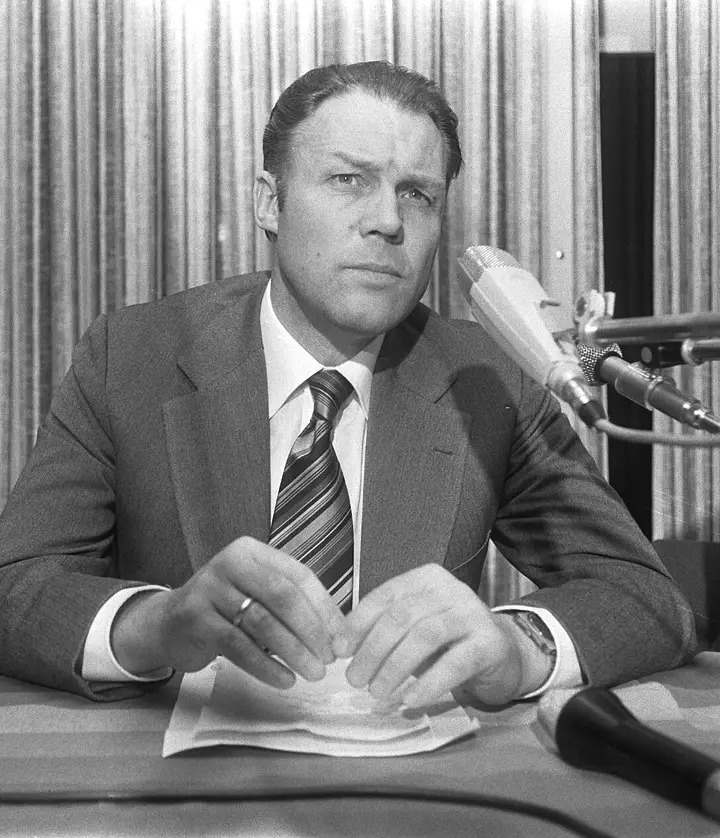
1971Rinus Michels, Johan Cruyff
A position belonged to the space, not the player.
Photo: Rob Mieremet / Anefo, Nationaal Archief, 1972 (CC0)
In the Ajax that Michels built, a number is a starting point, not a job. The side are European champions three years running, 1971 to 1973.
The left-back joins the attack up the touchline. In the old game that has a name: a hole left behind.
A midfielder drops into the full-back’s place, the winger comes inside, and Cruyff comes short to build.
Three men have swapped jobs and the side looks the same. The opponent looks for his man; the space is already taken.
1989Arrigo Sacchi
Twenty-five metres. The whole team.
Photo: San Siro. Fra Casa, 2024 (CC0)
In Sacchi’s Milan nobody chases an opponent. Two lines of four move together, according to where the ball is.
The ball goes wide and ten players slide that way at once. The distance from defence to attack never changes: about 25 metres.
When the ball is played back, the back line steps up. The striker left behind it is offside. Milan are European champions in 1989 and 1990.
1958Brazil
Four back, four up. When the left winger drops, the two in the middle are three.
Open on the board
1964Helenio Herrera
Every man has his man. Behind them, one man has nobody.
Open on the board
2009Pep Guardiola
The man on the ball always has two passes. The one that hurts goes to the third man.
Open on the board
2012Jürgen Klopp
When the ball is lost nobody runs back. The nearest three go to it.
Open on the board
The same move, two views.
The coach planning a session and the creator explaining a move build the same thing. What changes is where it goes.
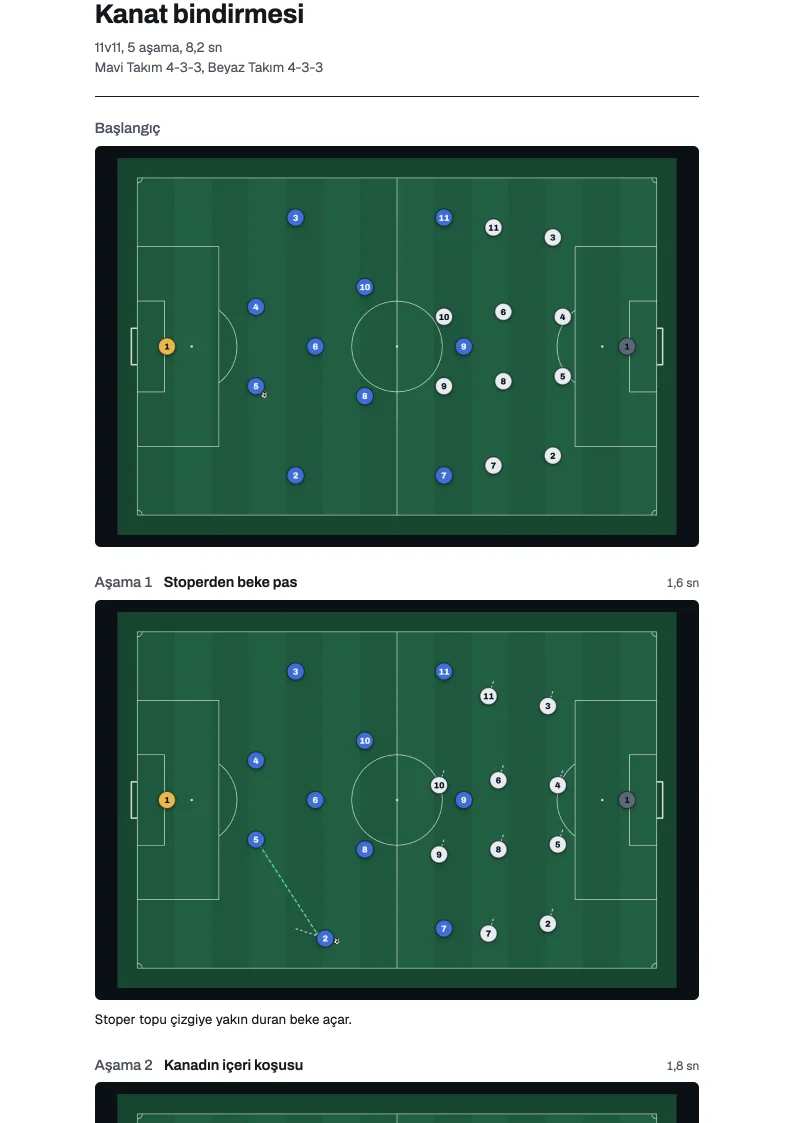
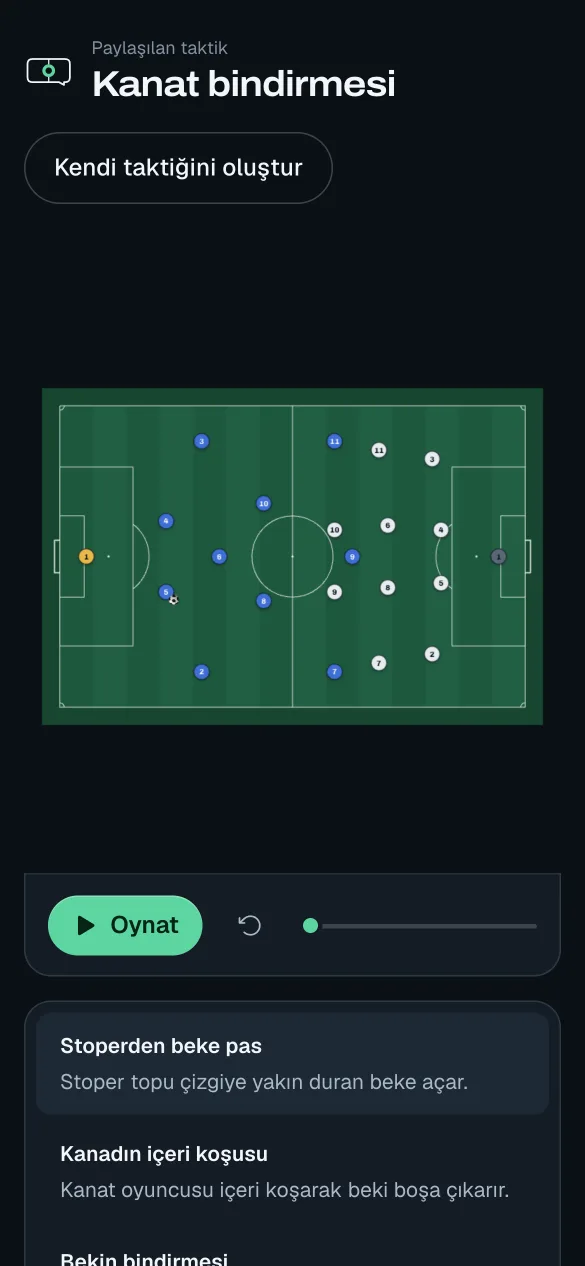
Build it phase by phase and file it in a folder. Your players open the link on their phones; you take the A4 sheet to the pitch.
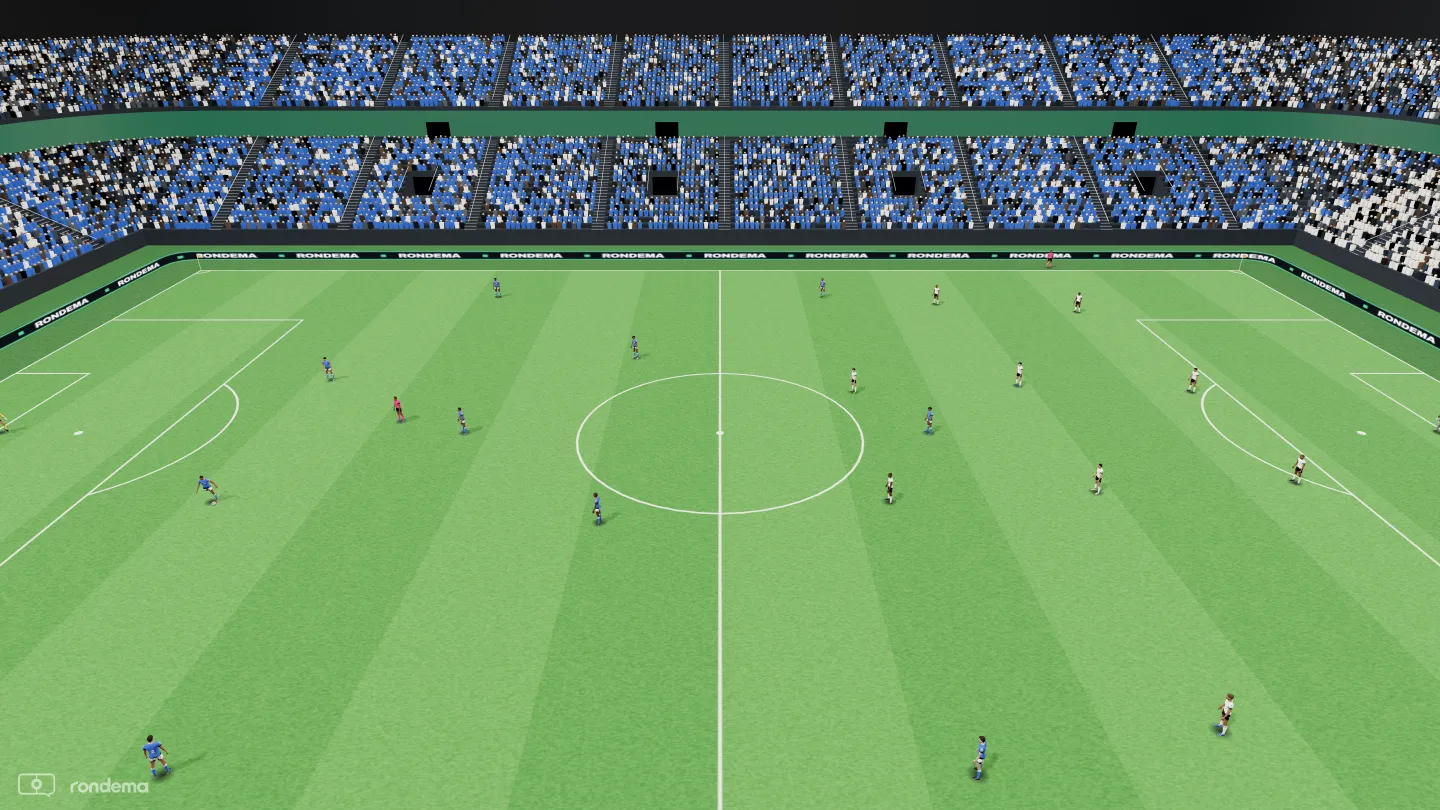
Build it once, play it in 2D and in a 3D stadium. Take it as a picture, GIF or video and post it.
Start without an account; create one to move your boards to the cloud.
For coaches and creators who prepare every week.
The price will be set after a pilot with the first coaches. A Team plan with a shared library, for coaching staffs at one club, will also follow the pilot.
No. Open the board and start working; your work is saved in this browser. When you want it on another device, create an account and move your boards into it.
Yes. On a phone you can view the pitch, play the animation, move players, rename them and share. Hold the phone upright to draw, so the pitch fills the screen; turn it sideways to watch in 3D.
No. The 3D view runs on your browser’s own graphics support. If a device can’t open 3D, your work is kept and you carry on in 2D.
Every edit is saved on this device the moment you let go; reload the page or lose the connection and it is still there. With an account it syncs to the cloud, and the same board opens on your phone and tablet.
The screen won’t say “Saved”; you get a retry and a project backup download instead. Deleted cloud boards can be restored from the bin for 30 days.
Yes. Every drag is one step; undo brings back formation, drawing and phase changes.
Anyone who has the link. You can turn sharing off at any time, and the link stops opening. You can hide youth players’ names and share with numbers only.
A shared version is fixed. Keep editing the board and the link stays the same until you update it.
A PNG of the moment you choose, a 2D video and a project file you can reopen. 3D video comes with the Pro plan.


